Over the past half century, colonial and interventionist narratives concerning Iran have increasingly permeated sections of progressive political discourse, including anti-war movements and Western intellectual circles. Often presented as humanitarian concern or democratic solidarity, these narratives rely on subtle forms of framing and dehumanisation that frequently escape critical scrutiny, even among committed activists.
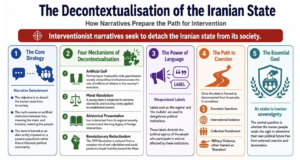
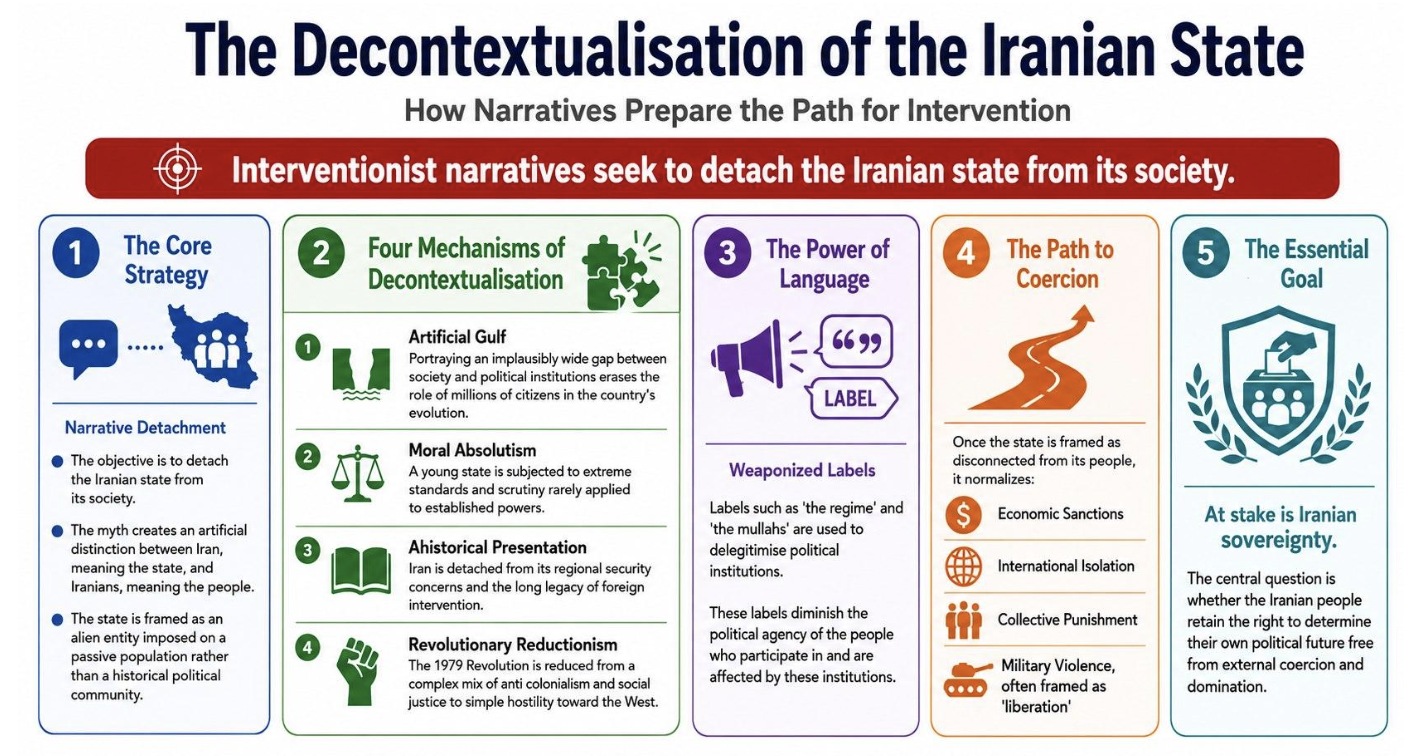
At their core, such narratives seek to detach the Iranian state from the society that produced, sustains, and continuously reshapes it. Rather than engaging with Iran as a historical and political community, they construct an artificial distinction between “Iran” and “Iranians”, treating the former as an alien entity imposed upon an otherwise passive population.
This process operates through several recurring mechanisms. First, it portrays an implausibly wide gulf between Iranian society and its political institutions, obscuring the role of millions of citizens in shaping the country’s political evolution. Second, it subjects Iran to a level of scrutiny and moral absolutism rarely applied to established powers, holding a relatively young state to standards that many mature states would struggle to satisfy. Third, it presents Iran in a static and ahistorical manner, detached from its regional environment, security concerns, and the long legacy of foreign intervention that has shaped its development. Finally, it reduces the 1979 Revolution, a complex synthesis of anti-colonial struggle, social justice aspirations, spiritual traditions, and demands for national self-determination, to a simple expression of hostility towards the West.
Lost within these narratives is a more fundamental reality: contemporary Iran remains engaged in a struggle to preserve its political sovereignty. Like many post-colonial states, Iran’s development has not occurred under conditions of geopolitical neutrality. Since the revolution, it has faced sustained efforts to constrain, isolate, pressure, and ultimately reshape its political trajectory from outside. The tensions, contradictions, and shortcomings visible within Iranian society and state institutions cannot be understood apart from this context. They are, in part, the product of difficult and ongoing trade-offs made by a relatively young political order seeking to defend its independence in a hostile regional and international environment. This does not place Iran beyond criticism. Rather, it requires that criticism be grounded in historical and geopolitical reality rather than in abstract standards applied selectively.
Once the separation between state and society has been established, the path is opened for the normalisation of coercive policies. A population portrayed as disconnected from its state becomes easier to subject to sanctions, isolation, collective punishment, and even military violence, all in the name of liberation. Language plays a significant role in this process. Terms such as “the regime”, “the mullahs”, and other exceptionalising labels are not politically neutral descriptions. They function to delegitimise political institutions that would otherwise be discussed in conventional state-centred terms and, in doing so, diminish the agency of the people who participate in and are affected by them.
For anti-war movements, resisting war requires more than opposing military action. It also requires challenging the narratives that render certain states uniquely illegitimate and certain populations uniquely expendable. Beneath the noise of competing narratives lies a central question: whether the Iranian people retain the right to determine their own political future free from external coercion and domination. What we are witnessing is not simply a dispute over a government, but an ongoing struggle over Iranian sovereignty itself.
Reference:
Mehrgan, O. “Rendering Tehran Bombardable, Notes on a Self-Targeting Subjectivity.” Parapraxis Magazine, March 2026.